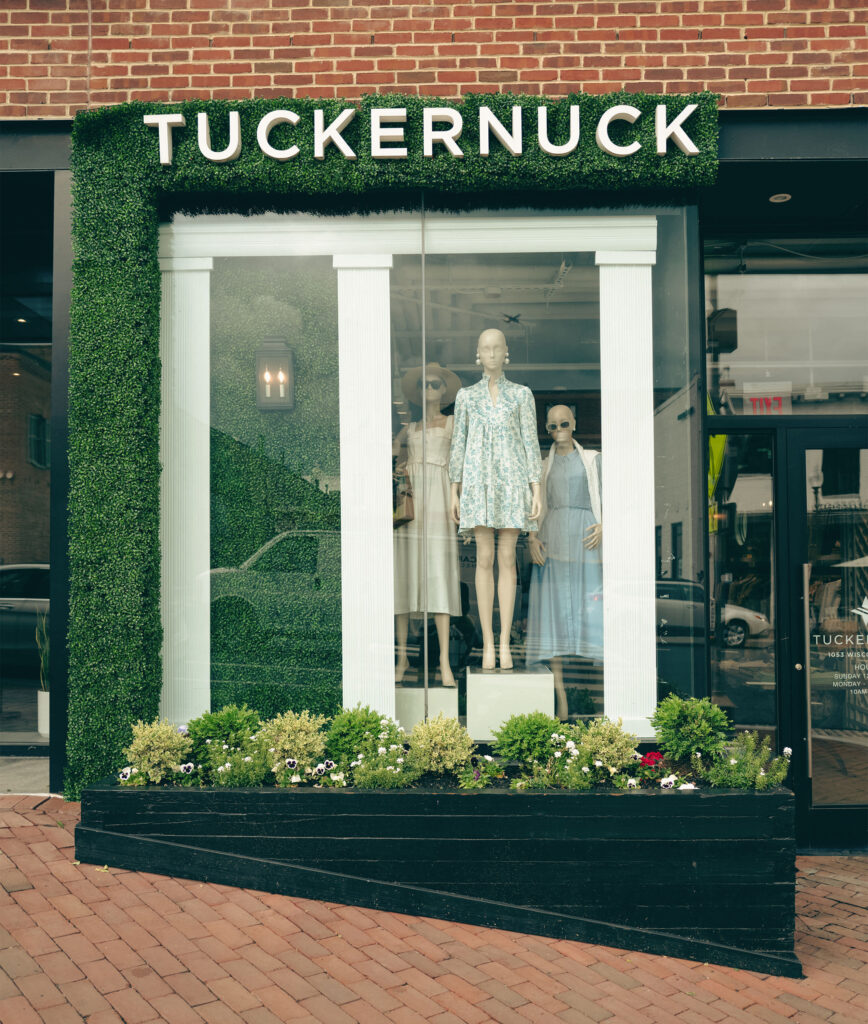
Since 2012, the clothing brand Tuckernuck has gone from a tiny retail operation above a Georgetown garage to a nine-figure empire of ruffled collars and tweed. Initially an e-commerce boutique that curated upscale brands, Tuckernuck now has its own in-house label and two brick-and-mortar stores, one by the Georgetown waterfront and the other on New York’s Upper East Side. Its “classic with a twist” aesthetic, the cofounders say, is crafted for exactly the kinds of women who run DC: ambitious, professional, wanting to look put-together without burning too much energy on clothes. It’s working. “Someone needs to do an exposé on the absolute chokehold the Tuckernuck shift dress has on the Capitol Hill girlies rn,” tweeted one congressional reporter last July. Weeks later, the Washington Post wrote up the brand’s “Jackie” dress as the it item for female political staffers at the RNC.
Tuckernuck’s popularity isn’t limited to Washington, but the brand has local roots. Sisters Jocelyn Gailliot and Maddy Grayson grew up here, attended National Cathedral School, and later launched the company with Grayson’s college friend September Votta. Today, Votta and Grayson live in Georgetown, while Gailliot lives in New York. Recently, I met them for an interview at Tuckernuck’s West End office space, which is expanding to a footprint about twice its previous size. The company is clearly in a growth phase. Its relocated Georgetown flagship—in a bigger storefront, up Wisconsin Avenue at N Street—is slated to open in early spring.
Maddy and Jocelyn, you grew up here. How has the city shaped you?
Jocelyn: Oh, we’re diehard DC fans. We grew up starting businesses on the streets of Georgetown from, like, literally the moment we were born. Every time there was a snowstorm, we would shovel all the homes in Georgetown. We had lemonade stands, we had babysitters clubs. It was fun for us to hustle and start these little businesses.
When you grow up in DC—or back then—it was more about families and friendships. At our schools and things, you saw people from all different political backgrounds and careers, dads that were friends on the sidelines, cheering each other on. That’s what came first.
And we were shaped by the fact that DC was full of really smart, busy, successful people, but also was a place that was really livable, and you could have this fun, full life—that’s the mission of Tuckernuck and the type of people that we try to service.
Tuckernuck initially just sold clothes from other brands, but you started designing your own clothes in 2019. Where do you find aesthetic inspiration for that?
Jocelyn: We get inspiration everywhere. It’s actually painful: You can’t turn it off. Sometimes you just don’t want to look at the world that way—you know, reading the tag off of every friend’s back, or my kids are like, “Mom, why are you taking creepy photos of those people walking down the street again?”
I live close to the Met, so I love to walk in and take photos of details in portraits, like sleeves or necks. And then September is the guru who takes all these design ideas and turns them into real products. There’s a gorgeous dress right now that’s almost sold out, a gown that’s white and black, and we were inspired by Grace Kelly movies from the ’40s. But it’s everything: coffee-table books, museum trips, vacations, what people are wearing on the slopes. We tried to take my daughter’s little clothes when she was, like, three and make them adult size. Obviously, we get a lot of inspiration from the outfits our moms and grandmothers wore.
Maddy: The Margot heel was inspired by Nana, I would say.
Jocelyn: Yeah. And also our whole heritage polo collection is based on our dad’s old polo shirts that were weathered and worn. So the inspiration is everywhere, which is why we’re saying you can’t turn it off, and you start to go insane at times.
Maddy: But we always start every season with a consumer mindset. So we say, “Okay, let’s look at what is happening in May and June.” We think of the events and the activities.
Jocelyn: Yeah, we actually had to try to create a little bit more framework. So we start with What is she doing, where is she going, what does she need? That allows us to have a little bit of a boundary, so we can’t just go totally off the rails.
To help guide the business, you invented three customer archetypes named Millie, Summer, and Charlotte. Who are they?
Jocelyn: Starting from day one, we felt like we had to define the women that we were curating and designing for. Summer tends to be a more bohemian, free-spirited persona. She’s willing to take risks on prints and things like that. She tends to be a bit more [popular] in the South.
Millie is more classic. She loves heritage pieces. She loves tailoring. She loves things like tweeds and separates. She likes to be a little understated, but she has some bold jewelry sometimes. And then Charlotte—we picked her name from Charlotte from Sex and the City—is more feminine, loves puffed sleeves, waist-defining things.
Maddy: She’s girly. A ruffled collar, pearls. I tend to identify with her myself.
September: Sometimes we say that our bestsellers are appealing to at least two of those girls.
Oh, did that apply to the Jackie dress, the one that was so popular on the Hill?
September: Yeah, the Jackie dress applied to both Millie and Charlotte. Charlotte from the feminine braided details, and the fact that it was tweed. And then Millie being that classic shift dress that we historically have always done well with.
I’ve read that Tuckernuck is particularly beloved among Republican staffers. What do you guys make of that?
Jocelyn: We always laugh. Everyone wants to make everything political these days. First of all, we’re very popular amongst both parties, and we have a lot of clients on both aisles. For us, it’s always been the mission of “Let’s inspire a fun, full life.” That’s something that everyone can be excited about.
When you’ve been asked to comment on this in the past, you’ll sort of step away from it. Some brands lean really far into politics, like “We stand for this, these are our politics, these are our values.” You all seem to have made a choice to not do that and to maintain a broader, bipartisan appeal. I’m curious what that decision-making has been like.
Jocelyn: I think because, from our perspective, we really believe in things that are bipartisan. Especially in this day and age, we want to be a place where everyone can find something in common. It’s not trying to be wishy-washy, it’s just true.
September: I think from the beginning, we’ve always said that people have wanted to bucket us—as a New England brand or an East Coast brand—but we always wanted to be attainable and approachable for the whole country and not just a small subset of it. So we are trying to be everything to everyone, maybe to a fault sometimes.
We saw so many of our friends not stick around in the workplace because it was too hard to leave their child at home. And we wanted a culture where children were allowed.
I also wanted to talk about how Tuckernuck retains employees–specifically, working moms–because that’s a point of pride for you guys.
Jocelyn: Between the three of us, we’ve had 12 children since we started the company. We saw so many of our friends not stick around in the workplace because it was too hard to leave their child at home. And we wanted to build a culture where children were allowed, where they were supposed to be there. Our children have been to trunk shows, they’re doing inventory counts. On spring break, my kids come to DC and they’re working in the stockrooms. They’re receiving inventory. They’re working with the design teams, learning how to sketch.
When we were looking to build out our new office space, we were really focused on “How can we retain these really bright, smart, creative women [who work for us]?” I always thought about how hard it would be to have to leave your child behind at three months old with a stranger, especially your first. We wanted to make sure that we had a minimum of four months maternity leave.
And your office also has a day-care center.
Maddy: That’s a reason why we chose this building, because there was a daycare in here already and it had a great reputation.
Jocelyn: We thought, okay, no one will be scared to leave their child if that child gets to carpool in with you every day and they’re just on the first floor and you can pop down and see them and visit them and know that they’re happy. So we offer up to $20,000 per child for daycare for all of our employees who work in our building. They bring their children in, and at 5 pm they all run downstairs and pick their kids up. We have a Tuckernuck kids’ room in the office space where they can go and play if a mom needs to finish a work call or something like that.
Our kids grew up in this environment, and it made us able to build what we wanted to build. We wanted to make sure that other women—and men—were able to have that same type of culture and continue to help us build the company.
DC isn’t known as a fashion capital. Who have you looked to here for style?
Jocelyn: DC has so many incredibly stylish women. I love Deeda Blair’s style. And Sally Quinn—we always go back to photos of her from the ’80s and ’90s.
Maddy: Katharine Graham is a source of inspiration, and Bunny Mellon had really good style.
September: Without being too obvious, Jackie O. And all of the First Ladies—I think we look back to the times when they were in office and how they could set the tone for the nation.
Your new Georgetown flagship store is slated to open this spring. What details are you most excited about?
Jocelyn: Oh, the changing rooms.
September: Yeah, we’re all passionate about changing rooms.
Jocelyn: When we talked about our dream store, one of the things we started with was “What do we not like when we’re in a store?” And it was always changing rooms—when someone’s trying to awkwardly get you a new size and you’re half naked and trying to open the curtain. So all of our changing rooms have a door, but then they have a mini door right next to it, and it allows [employees] to put new clothes and new sizes in the changing room, but they can’t see anything. You still feel fully discreet.
September: And this location, too, has a lot of meaning for all of us because it’s in the heart of Georgetown, where we always wanted to be—a corner lot with floor-to-ceiling windows on either side. It’s across from Martin’s, where we always do the after-party to our Christmas party. So in a lot of ways, it’s everything we’ve always been wanting.
This article appears in the January 2026 issue of Washingtonian.