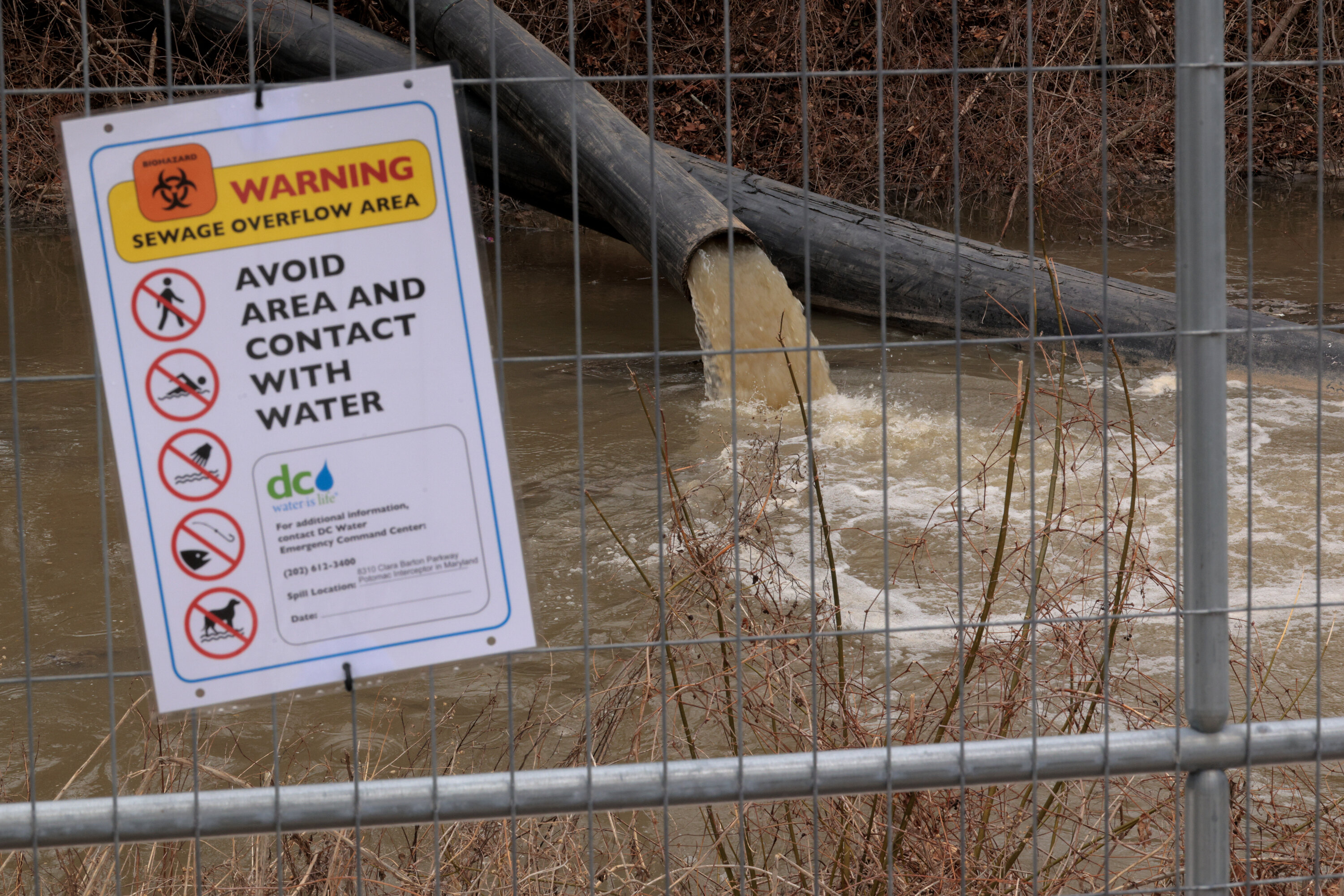
More than a month after one of the largest sewage spills in US history, lots of harmful bacteria is still swimming around in the Potomac River, according to recent testing results from the Potomac Riverkeeper Network.
The January 19 Potomac Interceptor Pipe sewer line break happened to coincide with a spate of extremely cold weather across the DC region, so a lot of the dirty river water had been frozen until a recent string of above-freezing days. The Potomac Riverkeeper Network’s Dean Naujoks told Washingtonian about two weeks after the spill began that experts were unsure how the contamination would play out once that ice started thawing—now, we’re getting an idea.
E. coli levels measured at affected river areas have shown improvement overall since the early days of the spill, per a Friday press release from the Potomac Riverkeeper Network. However, conditions appeared to worsen at the Lock 10 spill site in Cabin John over the course of the past week as temperatures warmed; water quality samples taken on February 12 show E. coli levels approximately 123 times the safe limit for human contact, while levels measured on February 17 amount to about 197 times that limit at the same location. The nonprofit is also finding unsafe E. coli levels as far as seven miles downstream from the spill site at Fletcher’s Cove. “This demonstrates rain and snowmelt may release more residual sewage into the Potomac, and E.coli levels will continue to fluctuate with weather events,” Potomac Riverkeeper Network president Betsy Nicholas said in the release.
In addition to E. coli, the Potomac Riverkeeper Network has also seen a recent increase in Staph aureus (the bacteria that causes staph infections) throughout the river. On February 3, 22% of sampled sites tested positive for staph; by February 2, that figure had doubled. On February 12, the Riverkeepers found that the pathogen was present at Fletcher’s Cove and at another site 20 miles further south. Naujoks says, per the release, that the organization cannot confirm whether the staph is directly linked to the sewage—wildlife can also carry it—but “the percentage of positive hits exceeds typical US surface water levels.” The organization also found MRSA, an antibiotic-resistant strain of staph, at the spill site on both February 3 and 12; it was also measured hundreds of feet downstream from Lock 10 at a recreation beach area.
No additional sewage water has overflowed for more than ten days, according to DC Water, which announced Thursday that crews have successfully reached the damaged section of the Potomac Interceptor Pipe and that repairs are expected to be fully complete by mid-March. DC Mayor Muriel Bowser, who visited the spill site Thursday, has declared a local public emergency—the first step toward receiving federal support through a Presidential Emergency Disaster Declaration request. She hopes President Trump’s administration will cover all of the repair costs; the White House told the Washington Post in an email yesterday that the Environmental Protection Agency and the Federal Emergency Management Agency have started coordinating with DC authorities.
Trump, who inexplicably blamed Maryland Governor Wes Moore for the sewer line break earlier this week, is reportedly keen to fund the repairs because he’s “worried” that the river will still smell like poop during his planned celebrations for the United States’s 250th birthday this summer.
“We are gratified that Mayor Bowser has in her declaration of emergency sought the necessary funds; we hope that the political fingerpointing will stop and that we can all focus on the importance of repairing the infrastructure damage, monitoring and maintaining it in the future, and establish a program of daily water quality monitoring to assure the public’s confidence in the safety and health of the Potomac River,” Nicholas said in the Potomac Riverkeepers’ release. The organization still advises folks to stay out of the water for now—if you’re tempted to dip a toe in anyway, let these pictures dissuade you.