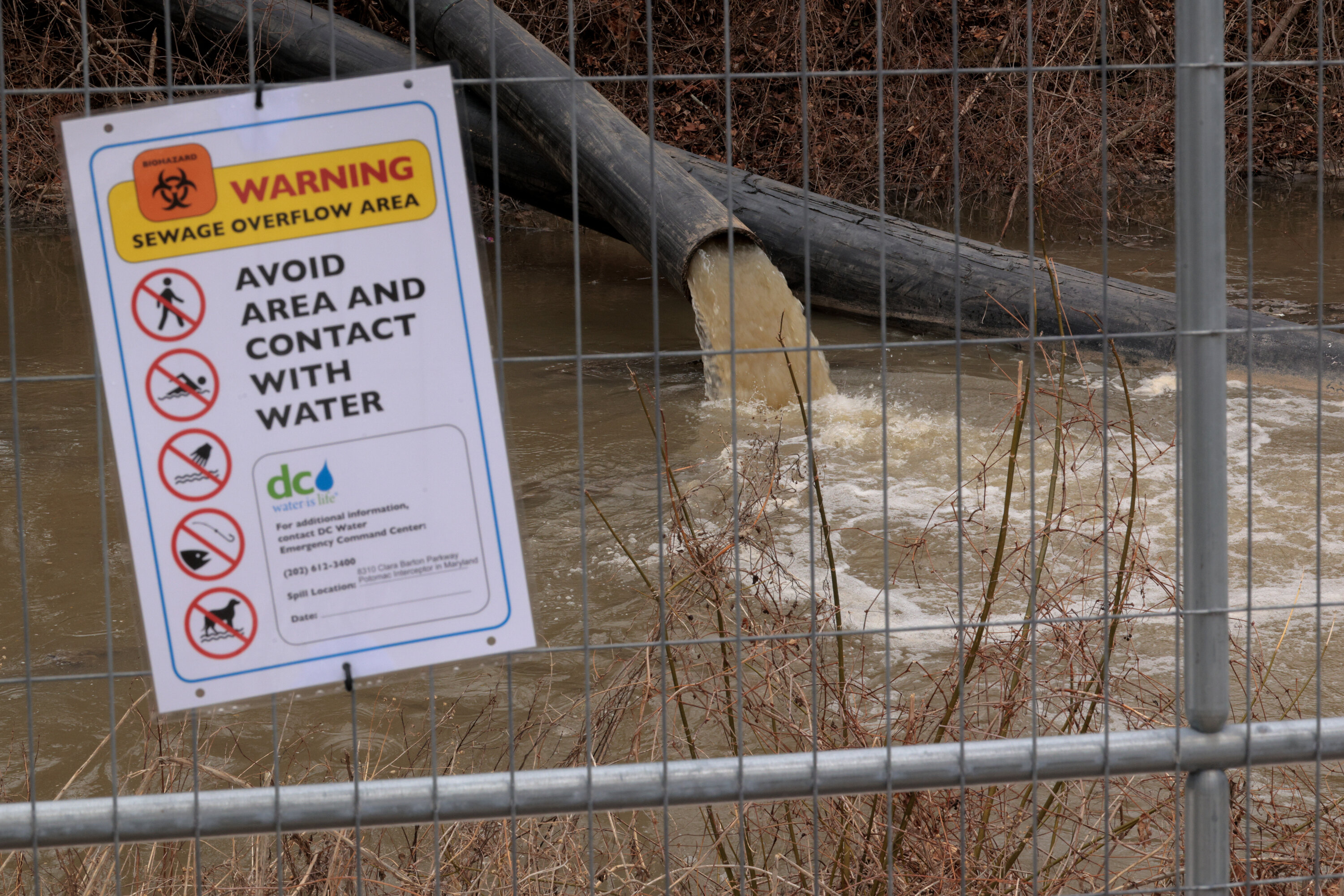
Over the weekend, President Donald Trump approved a federal emergency declaration regarding the sewer line break that has plagued the Potomac River since January 19. The move comes just days after DC mayor Muriel Bowser declared a local public emergency, asking for the federal government’s help to fund and otherwise support the cleanup effort.
This is good news for DC: Trump’s action authorizes the Federal Emergency Management Agency “to identify, mobilize and provide, at its discretion, equipment and resources necessary to alleviate the impacts of the emergency,” the agency said in a release Monday. Bowser requested that the administration reimburse all related expenses incurred by the District and DC Water; FEMA noted in its release that it will cover 75% of the costs, “allowing the agency to tap into the expertise and resources of other federal agencies.” The agency said it is working with the Environmental Protection Agency and DC’s government to coordinate federal resources, speed up repair of the broken Potomac Interceptor Pipe, assist in cleaning up more than 240 million gallons of raw sewage that has been released into the river, and provide ongoing water quality testing, according to the release.
FEMA is part of the Department of Homeland Security, which has been shut down for 10 days. Last week, DHS ordered the agency to halt the deployment of hundreds of aid workers to several disaster areas amid the debacle—even though the Disaster Relief Fund that covers most FEMA deployments is not affected by the shutdown. “Democrats in Congress have shut down @FEMA funding—leaving our hard working employees to work without pay—yet FEMA is now stepping in to coordinate cleanup of one of the largest raw sewage spills in U.S. history,” Homeland Security secretary Kristi Noem posted on X last Monday. “Democrats are withholding paychecks from the men and women of @dhsgov while they clean up this Democrat-created disaster.” Three FEMA officials told CNN Wednesday, before Trump officially declared the spill a federal emergency, that the agency had yet to send significant resources to the site.
While it’s not yet clear how FEMA’s early response will be affected by the shutdown, the promised help is welcome. DC Water is hoping to restore full functionality to the Potomac Interceptor Pipe by the middle of next month—but first, crews must excavate the damaged section to remove rock and debris blockage that would be unsafe to dislodge manually. “DC Water is coordinating with National Park Service, Environmental Protection Agency, Maryland Department of the Environment, and USACE on the Environmental Restoration Plan and are looking at options to begin implementing some remediation measures in advance of the larger restoration work once the emergency repair is complete,” the agency said in a press release Sunday.
DC Water says that while there has been no additional sewage overflow since February 8, people should still avoid contact with the river downstream of the Cabin John spill site. Melting ice appears to be releasing another gush of bacteria—including E. coli and Staph aureus—into the water, the nonprofit Potomac Riverkeeper Network warned Friday.
DC Water will host two public meetings this week, at which community members can “learn more about DC Water’s response, current system status, and next steps in emergency repair and long-term rehabilitation efforts.” The first will be held this Wednesday, February 25, at the agency’s headquarters (1385 Canal St., SE) at 7 PM and the next will take place on Thursday, February 26, in the cafeteria of Bethesda’s Walt Whitman High School (7100 Whittier Blvd.) at 7 PM.