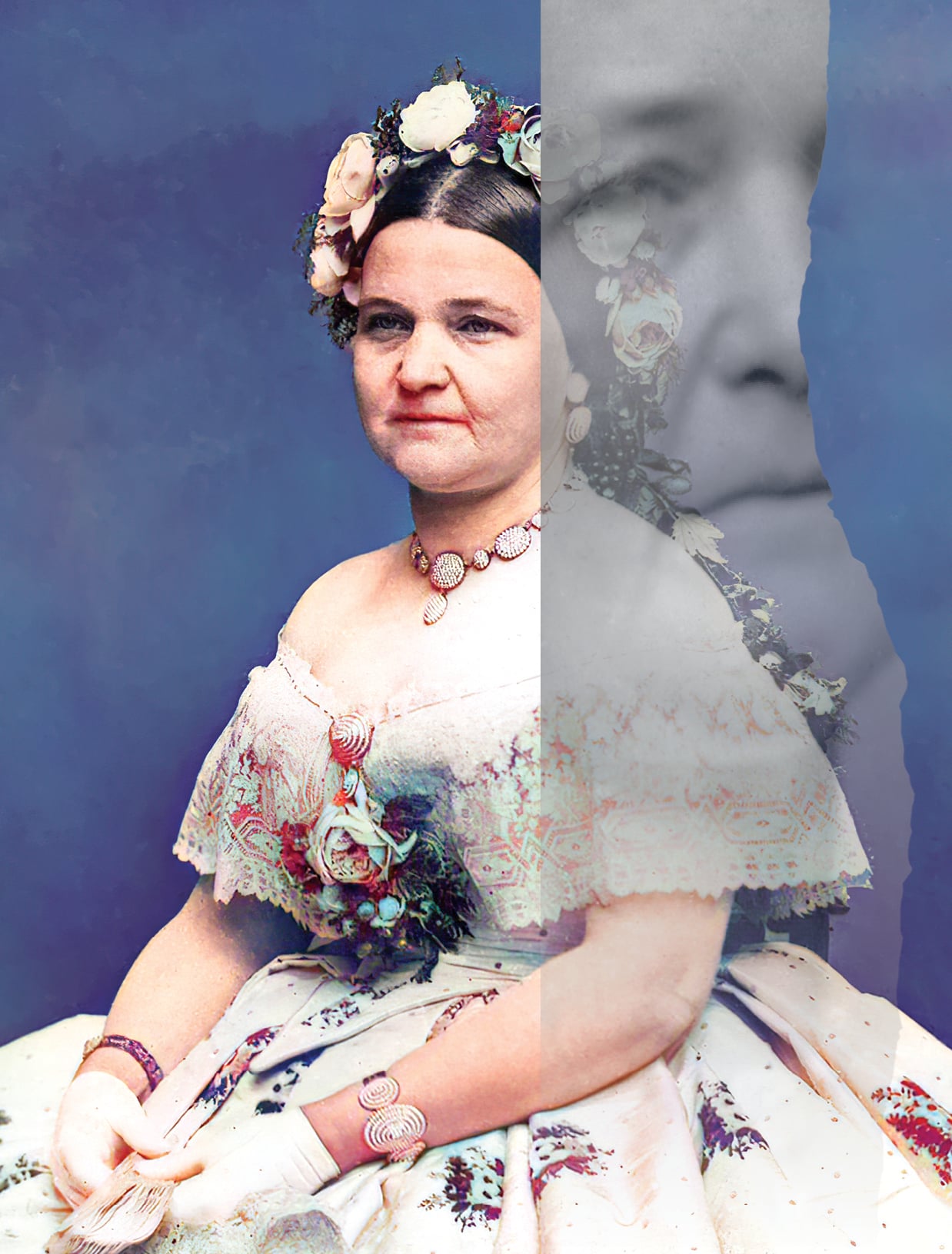
Inauguration Day, March 4, 1861. On a brilliantly sunny day in Washington, arguably the biggest moment of Mary Todd Lincoln’s life, dreams and reality collided.
As the President-elect’s coach clattered down Pennsylvania Avenue just ahead of hers, Mary could hear the crowd’s cheers and feel their warm embrace. But she also could see the ominous show of security forces and sense the unrest. General Winfield Scott had turned Washington into a fortress after rumors swept the city that Southern rebels would try to kidnap or assassinate Lincoln before he could be sworn in. Infantrymen lined the streets. Sharpshooters stood on rooftops and in the windows of the Capitol. Marshals and mounted soldiers surrounded the open carriage that carried Lincoln and President Buchanan, with orders to shoot anyone crowding it. Having heard that rebels would attempt to blow up the platform where Lincoln would speak, Scott stationed armed militiamen beneath and around the podium. Mary sat behind her husband on the inaugural stage, with their three sons and a legion of Todd family members. Her cousin Elizabeth Todd Grimsley keenly felt the tension, later describing the “sea of upturned faces, representing every shade of feeling; hatred, discontent, anxiety, and admiration.”
This emotional kaleidoscope would become Mary’s reality. She had long believed becoming First Lady was her destiny, the role she had aspired to her whole life. She envisioned herself as mistress of the land, a social queen, a fashion doyenne, and a supportive spouse who commanded respect and admiration. Her only previous foray into the Washington power vortex had been a disaster: As the wife of a lowly freshman congressman, she and her toddlers were forced to live in a cramped rooming house with all men while her husband worked long hours. But now she was moving into the city’s most prestigious address. She would bring to 1600 Pennsylvania Avenue the impressive assets that had made her popular in Springfield, Illinois—an exuberant personality, a gift for cultured and educated conversation, a disarming outspokenness, and a love of politics. Still, this move was beyond anything she could have anticipated, and she had neither the experience nor the temperament to manage everything thrown at her. Before unpacking, before taking any official action, she was faced with the hard truth that half the nation despised her husband—and, by extension, her.
This would have been challenging for even the most secure and equanimous personality. Mary’s self-doubt, anxiety, and emotional immaturity made it crushing. Her roots in the divided slave state of Kentucky—which was still clinging to the hope of a compromise that would restore the Union to the status quo—put her in everyone’s cross hairs. Defiant Southerners saw her as a traitor to her birthplace, while some Northern abolitionists believed her to be a spy for the Confederacy and blamed her for Lincoln’s caution on emancipation. Complicating these impressions, nine of Mary’s brothers and brothers-in-law would align with the Rebel states, and three would die fighting for them.
Lincoln’s conciliatory message on that tense Inauguration Day did little to assuage the South’s hatred toward him. “We must not be enemies,” he implored, calling forth “the better angels of our nature” to keep the Union intact. Seeking to stem the tide of secession, he vowed not to interfere with slavery in the states where it already existed. His opponents were not appeased. All they heard was that he was adamant about not extending slavery to new states. While Northern newspapers praised his speech, Southerners slammed or ignored it. In Washington, there was mostly relief that violence had been averted. Horace Greeley, editor of the New York Tribune, was sitting behind Lincoln during the event and said he was “expecting to hear . . . the crack of a rifle aimed at his heart” at any moment.
Grateful to make it to the White House unharmed, Mary focused on what was immediately ahead: her debut. Harriet Lane had arranged an elegant dinner for the Lincolns and their houseguests. Just before 10:30 pm, the party gathered for a caravan to the inaugural ball, taking place in a temporary building that could hold 2,500. Intent on making her first fashion splash, Mary had chosen a pale-blue silk gown with a lace overlay. She finished off her look with the seeded-pearl necklace and bracelet that Lincoln had purchased for her at Tiffany’s.

Guests lined the pathway as Mary paraded the length of the hall on the arm of her old beau, Senator Stephen Douglas. To outsiders, he might have seemed an odd choice for an escort. The Democrat had been Lincoln’s rival for years and, until the 1860 election, had bested Lincoln at nearly every turn. But Mary had never harbored the resentment toward the Little Giant that she held toward other foes. In defeat, Douglas had made clear he would support Lincoln in this perilous moment. As was the practice at the time, the First Lady and President entered events on the arms of others, a custom Mary hated, because it meant her husband was to escort another woman. She eventually abolished the practice.
She envisioned herself as mistress of the land, a social queen, a fashion doyenne, and a supportive spouse who commanded respect and administration.
On this evening, though, Lincoln led the procession with the Vice President. Mary danced the quadrille with Douglas and stayed past 1 am, outlasting the President. After years of detached or unorthodox First Ladies, she was an anomaly and a curiosity. Observers seemed perplexed by her “ease and grace” and that she had quickly adapted “to the exalted station to which she has been so strangely advanced.” For better or worse, she was an overnight celebrity—a dangerous elixir for an insecure woman who thrived on attention. Not since Dolley Madison, 50 years earlier, would a President’s wife make such a concerted effort to position the White House at the center of Washington’s social life. But never had a First Lady experienced the resistance and condemnation that Mary would endure.
Mary had spent her 42 years in two small towns, protected by family and friends. Considered an accomplished hostess in Springfield society, she was not known outside its insular community. That was changing, faster than she could comprehend. “Now, if she but drive down Pennsylvania Avenue, the electric wire thrills the news to every hamlet in the Union which has a newspaper,” a British journalist wrote in his diary. The eyes of the nation were upon Mary. Many were judgmental strangers, not inclined to forgive her shortcomings. She was needy and nervous, afloat in turbulent waters with no anchors—not even her husband, who was consumed by a looming war.
Old House, New Hostess
Mary’s first order of business was a tour of the White House. She was shocked to find peeling paint, ripped wallpaper, broken furniture, and threadbare rugs. The grand East Room, despite its sparkling chandeliers and frescoed walls, looked tired and neglected. An Ohio congressman said he was struck by “the bare, worn, soiled aspect” of Lincoln’s office. The “people’s house” did not even have a full set of matching china for formal entertaining. Mary was disappointed but not disheartened. Within a few months, she would have a $20,000 congressional appropriation to refurbish the 31-room mansion and accomplish her goal of making it a national showcase.
As always, Mary kept a vigilant eye on the men around her husband and was particularly vexed by William Seward, the new Secretary of State. She despised him, instinctively understanding that Lincoln’s chief rival for the Republican nomination thought himself smarter than her husband and was telegraphing that he had no intention of playing second fiddle. She wasn’t wrong—Seward believed he had a better grasp of the presidency than the man elected to the job—but her antagonism was so personal that she would order her coachman to avoid passing Seward’s home when she was out riding. “He twine[s] you around his finger like a skein of thread,” she warned Lincoln. Always immersed in political gossip, and a prodigious newspaper reader, Mary would not have missed that Seward was relentlessly trying to usurp Lincoln’s authority, going around him to subordinates and leaking news to the press.
The two men would eventually become allies and friends. But Lincoln skillfully stayed one step ahead in these early weeks, telling private secretary John George Nicolay, “I cannot afford to let Seward take the first trick.” When Seward threatened to withdraw from his cabinet appointment because Lincoln had ignored his demands on other picks, the President called his bluff. Seward relented, then attempted an ill-conceived power play. In a memo, he brazenly admonished Lincoln for not yet having put forth a domestic- or foreign-policy agenda; in offering a list of remedies, he volunteered to take over the administration’s decision-making and day-to-day operations. Seward thought Lincoln would agree to be a figurehead. Instead, the President dismissed the proposals and told Seward he would remain in charge.
Bolstering Mary’s qualms, Seward also made a bid to host the administration’s first major reception. Mary aggressively objected. Entertaining was her domain. On March 8, she threw open the doors to the White House for a massive party. She again wowed her guests, this time in a magenta water-silk dress, with bright red and white camellias adorning her hair. The event was unpleasantly packed. An entry line meandered down Pennsylvania Avenue, leading some impatient guests to climb in through the windows. “A motley crowd and terrible squeeze,” attorney general Edward Bates noted in his diary. Seward was absent, with press reporting he was “detained by illness.” More likely, he had been detained by pique. The Washington Evening Star later described the end of the party as a “tragic” scene, with guests caught in a crunch trying to find their coats and hats. It was one of the last times for many years that North and South would socialize together in the White House.
Mary’s arrival jolted the wealthy, insular Southern ladies of Virginia and Maryland who had dominated for decades.
Just as the election of the first Republican President had triggered a rapid reshaping of Washington’s power structure, so too was there a conspicuous shift in the city’s social order. Mary’s arrival jolted the wealthy, insular Southern ladies of Virginia and Maryland who had dominated for decades. “Women were a power here, as much, almost, as were its statesmen,” presidential aide William Stoddard observed, “and those of them who remain are slow to yield their old supremacy.” Rather than try to curry favor with the new First Lady, they snubbed her, with British journalist William Howard Russell noting, “The Washington ladies have not yet made up their minds that Mrs. Lincoln is the fashion. . . . They miss their Southern friends, and constantly draw comparisons between them and the vulgar Yankee women and men who are now in power.” Realizing that becoming mistress of the land was harder than she had anticipated, Mary begged her cousin Elizabeth Grimsley not to leave Washington. She ended up staying six months.
Throughout that time, fear gripped the White House. Hate-filled mail became so upsetting for Mary that she demanded that all incoming correspondence be screened. “I do not wish to open a letter, nor even a parcel,” she instructed Stoddard, “until after you have examined it.” General Scott kept the building surrounded by troops, which Lincoln found maddening. He didn’t want to feel confined to an armed fortress. When the entire family and houseguests fell ill soon after the inauguration, fears of a plot to poison the President caused panic. Doctors were called in. The culprit turned out to be food poisoning—“an over-indulgence in Potomac Shad,” as Mary’s cousin put it.
Power and Patronage
Determined not to let fear slow her down, Mary pushed forward. But after six weeks, she was drowning. She struggled to manage the complex household and its Byzantine budget. Her exhausted husband was unavailable to calm her nerves. Frustrated that there was no entertainment stipend, Mary sought to redirect money to her priorities, causing tension with White House aides. She tangled constantly with Nicolay, 29, who also operated as chief of staff, and 22-year-old John Hay, Lincoln’s other private secretary. They found it exasperating to constantly try to fend off Mary’s schemes to generate money while putting out the fires she was igniting. Their nicknames for her included “La Reine,” “Her Majesty,” “The Hellcat,” and “The Enemy.”
Frustrated that there was a no entertainment stipend, Mary sought to redirect money to her priorities, causing tension with White House aides.
Lincoln had earned $1,500 to $3,000 annually as a lawyer, and his $25,000 salary as President must have seemed like a fortune to Mary, an opportunity to save for the future. When she realized her husband was personally paying for some household expenses, she became upset. Money had been an obsession for her since her early married years, when her wealthy father was no longer supporting her. Financially naive, Mary tried all manner of dubious and unethical schemes to produce cash. Observing her “growing irrationality” about money, Stoddard was mystified by her ricochets between overspending and stinginess. She was so overwhelmed by the “horror of poverty to come,” he wrote later, that “during a few hours of extreme depression,” she wanted to sell the “very manure in the Executive stables, and to cut off the necessary expenses of the household.” But her fears would ebb and flow. Stoddard was perplexed at how she “could be one day so kindly, so considerate, so generous, so thoughtful and so hopeful,” then the next, “so unreasonable, so irritable, so despondent.”

Mary’s mood swings didn’t alter the financial reality: She couldn’t afford her ambitions for the White House. To her detriment, she confided in anyone who would listen, including staff. The mansion’s unprincipled groundskeeper, John Watt, showed Mary how to manipulate the ledger and pad bills, something he already had been doing by submitting vouchers for planting items that never appeared. She was all too happy to take his advice, but the extra cash generated for the household still wasn’t enough. Rather than scale back her aspirations and renovation plans, Mary ruffled feathers by abandoning state dinners in favor of less costly receptions—a move her husband initially opposed—and dismissing experienced employees so she could hire cheaper labor. (One journalist noted that the new staff was more befitting a restaurant than the White House.) Mary then asked Hay if she could personally receive the steward’s $100 monthly salary for taking on much of that work. Shocked by the inappropriate request, Hay rejected it. “I told her to kiss mine. Was I right?” he jokingly wrote to Nicolay. “There is no steward.” He added a few days later, “The Hellcat is getting more hellcattical day by day.”
It wasn’t long before Washington was abuzz with Mary’s behavior. As she struggled to pay for her ambitions, she realized how little she knew about the nuances of East Coast society. Who were the best caterers? Which were the elite stores? Who should be invited to her salons? Anxious to demonstrate that she and her husband were not rubes, Mary latched onto a man she liked but barely knew: William Wood, who had ingratiated himself with Mary during the Lincolns’ journey to Washington. By the time they arrived in the capital, she had decided he should be the commissioner of public buildings, a complex job with significant financial responsibilities for a man with no government experience. Wood played to her needs so effectively that she was blind to what others saw: a sycophant with questionable judgment.
A former hotel manager, Wood was among a collection of opportunists and rogues who, seeking to gain influence and pad their pockets, took advantage of Mary’s naiveté and desperation. The White House became an almost comical revolving door of odd characters, including Oliver “Pet” Halsted, a lobbyist for weapons dealers whom Mary had met on a vacation, and Henry Wikoff, a globetrotting dandy who had served prison time in Italy for kidnapping his heiress fiancée, part of a plan to seize her money. Mary assured Elizabeth Keckly, her seamstress, that her aims with this “unprincipled set” were strategic. She hoped to use their influence to boost her husband’s reelection chances and then “drop” them once a second term was secured. But political observers were aghast, with one journalist describing them as “common” men whose “flattery easily gained controlling influence over her.” In the coming years, spiritualists preying on Mary’s sadness would join this bizarre ensemble.
Lincoln named Wood the interim commissioner of public buildings on July 12. Mary sent flowers to Illinois senator Orville Browning, a longstanding Lincoln ally, telling him he would find a “true friend” in her if he supported Wood’s confirmation. However, an uneasy Senate let his nomination languish. It wasn’t the first or last time Mary would meddle in government business. Her efforts to get appointments for family, friends, and supporters did not go unnoticed, with gossip flying that she was being bribed with cash and gifts to influence her husband. While she definitely tried to bestow favors, there is no proof that she took money for it. Like any political operator, Mary mostly sought low-to-midlevel jobs for people she knew. She also weighed in on some senior appointments, with mixed results. Lincoln had the authority to turn over nearly the entire executive branch—it would be another 20 years before Congress would create the civil service, removing many federal jobs from presidential control—and he was very much in command of patronage, understanding its usefulness. He was under enormous pressure, too, juggling demands from clamoring Republican factions as well as Illinois friends, whom he was reluctant to appoint because of appearances of favoritism. “Do you know that you have not as yet appointed a single man from Illinois that was originally your friend?” Springfield friend Jesse Dubois curtly scolded him. Cabinet members, elected officials, and even newspaper editors who had supported Lincoln were seeking positions for their own supporters and friends.
Mary saw it as both her right and her duty to ensure that loyalists received appointments. Still, she was more of a string-puller than a powerbroker. But seeing the President’s wife wading into the patronage arena, and knowing she had his ear, was maddening to entitled, powerful men. She was only doing what they were doing—trying to take care of allies—but in 1861, it was unseemly for the First Lady to be involved in the patriarchy of politics. It brought her scrutiny and enemies. One newspaper editor huffed in letters to a friend that Mary was a “fool” and that some of Lincoln’s “most unfortunate appointments have been made to please his wife who is anxious to be thought the power behind the throne.” A correspondent for another newspaper, known for its stalwart support of the Republican Party, opined derisively that Mary had “made and unmade the political fortunes of men.” Not quite. But when influential men didn’t get what they wanted, it was far easier for them to crucify Mary than to take on the President.
Mary was perfectly comfortable appealing directly to cabinet members, who were equally comfortable rebuffing her. She leaned on Seward to appoint a Lincoln supporter from Ohio as US consul in Honolulu, who did not get the job. When she sent one young man with a note of introduction to Secretary of War Edwin M. Stanton, the cabinet member found the applicant unqualified and paid Mary a visit the next day. He cautioned her that appointments of people unfit for the job “strike at the very root of all confidence in the government, in your husband, you, and me.” Mary retreated and promised never to ask him for a patronage favor again.
She had better success in her efforts on behalf of family members, helping land a position in the Army’s rapidly growing administrative ranks for her sister Frances’s husband, William Wallace, who had been pressing Lincoln for an appointment. She claimed that her effort for Wallace was a “hard battle” and resented that her sister did not thank the Lincolns. One family member Lincoln was eager to give a job to was a promising Todd relative from Kentucky: Benjamin Hardin Helm, a West Point graduate and husband to Mary’s favorite half sister, Emily. Lincoln was fond of Helm, and when he learned that he had come to Washington seeking a military appointment, the President offered the young man a commission as a Union Army paymaster. As Lincoln’s request sat on the Secretary of War’s desk, Helm had second thoughts. Two weeks later, he turned down the offer and joined the Confederate Army, greatly disappointing the Lincolns.
A First Lady at War
In the weeks following the inauguration, Mary fretted over her husband’s health. He was grappling with what to do about Fort Sumter, manned by a small Union garrison on an island off the coast of the seceded state of South Carolina. Sumter was running out of supplies, but Lincoln feared that an attempt to fortify the base would trigger an escalation in tensions. The state’s Confederate leaders were demanding that the fort be evacuated. Lincoln was reluctant. His cabinet was divided. Adding to the pressure, Lincoln was being undermined by Seward, who was working a back channel with Confederate leaders, assuring them Sumter would be evacuated. During this period, Mary said Lincoln had “keeled over” with a migraine headache.
General Scott pushed Mary and her family to head north for safety. But Lincoln wanted her to stay, and she refused to abandon the White House.
Any hope of a peaceful resolution evaporated on April 12, 1861, when South Carolina’s militia bombarded the fort. Thus began the Civil War, the bloodiest conflict in US history, a four-year ordeal that would claim upward of 750,000 lives. With limited supplies and ammunition, Major Robert Anderson, Sumter’s commander, surrendered the next day. He saved the American flag on his way out and returned to Washington a hero. Three days after the attack, Lincoln called for states to send 75,000 troops. Mary was terrified Lincoln would be assassinated; Hay employed “some very dexterous lying” to calm her down.” As word spread that Washington might be attacked, General Scott pushed Mary and her family to head north for safety. But Lincoln wanted her to stay, and she refused to abandon the White House.

Producing 75,000 men was no simple task. The states had modest militias and small arsenals. Some governors refused the request. In neighboring Maryland, a slave state, officials blocked Union soldiers from passing through. Lincoln was under siege from all sides—the South, the North, and the press, where the loudest voices were faulting him for seeming weak. When he clarified that the troops were needed to protect the capital, some trickled in. By April 18, about 50 armed volunteers from Kansas had taken up residence in the East Room, setting up camp on top of the fine Brussels carpet under crystal chandeliers. They were soon joined by a Massachusetts regiment that had fended off a mob in Baltimore. But it was the Seventh New York Regiment, stomping up Pennsylvania Avenue on April 25 with bands playing, that lifted the town’s spirits. Mary and her friends watched from the White House’s windows. By May, thousands of soldiers were making their camps in and around the government’s buildings. She wrote to a friend in Springfield that “if there is safety in numbers, we have every reason to feel secure.”
Meanwhile, Southern sympathizers were horrified. A friend of an Alabama’s senator’s wife described “[o]ur beautiful capital, with all its artistic wealth, desecrated, disgraced with Lincoln’s low soldiery.” Feeling somewhat relieved, however, the Lincolns hosted a reception on May 9 for military officers and the cabinet, with Anderson singled out to be honored. Mary impressed a New York Times reporter in attendance by listening intently as he described the soldiers’ needs. He was also fixated on her appearance. “The beauty of her arms and shoulders,” the correspondent wrote in a manner not unusual for the period. “They were very white and polished as marble.”
The next day, Mary embarked on her first official travel as First Lady, an extended trip north on an unprecedented mission. Accompanied by her cousin Lizzie and William Wood—as well as newly promoted Brigadier General Robert Anderson for part of the journey—she would be representing her husband’s administration at Union rallies and visits to military encampments. There was intense public interest in Anderson, who had acquired a celebrity stature after Fort Sumter. For Mary to accompany him by train to Philadelphia, and be part of his entourage as a welcoming committee escorted them from the depot to their hotel, put her front and center in a way that went far beyond serving as chief White House hostess. She was breaking new ground, politically and personally, helping reshape the First Lady’s role. Unlike her predecessors, who had stayed mostly out of the public eye, Mary had a strikingly different ambition. She intended to be seen.

From the forthcoming book An Inconvenient Widow: The Torment, Trial, and Triumph of Mary Todd Lincoln, copyright © 2026 by Lois Romano, to be published by Simon & Schuster. Printed by permission.
From the forthcoming book An Inconvenient Widow: The Torment, Trial, and Triumph of Mary Todd Lincoln, copyright © 2026 by Lois Romano, to be published by Simon & Schuster. Printed by permission.
This article appears in the May 2026 issue of Washingtonian.