You can read part one of this article here.
A week after Robert Mueller took over as FBI director, the terrorist attacks of September 11, 2001, transformed his job. Gone were the days when the American people would be satisfied with after-the-fact prosecution. The emphasis now was on preventing the next attack.
Mueller, whose experiences as a Marine and a federal prosecutor shaped his leadership style, has overseen the deployment of FBI agents to the front lines of the war on terror around the world.
In December 2001, just after the US invasion of Afghanistan, the first FBI team of eight agents arrived in Kandahar—the first combat deployment of FBI agents since World War II.
Since then, more than 500 FBI personnel have been sent to Iraq and Afghanistan to investigate bombings and attacks and to collect biometric data on detainees and interrogate them. Another 500 have worked at the US base at Guantánamo Bay, Cuba. Agents have worked on cases in Iraq such as the Jordanian and Turkish embassy bombings and attacks on the headquarters of the Red Cross and United Nations.
The most controversial aspect of the FBI’s role in the war on terror has been its participation in “extreme interrogations” by the military and the CIA at sites such as Abu Ghraib prison in Iraq and Guantánamo Bay, known in military parlance as Gitmo.
The terrorism investigations posed three challenges to the FBI: First, in the war zones, the agents were dependent on military protection and so worked hard to maintain cordial relations; second, the FBI usually was not the lead investigative agency, so it didn’t have control over the treatment of detainees; and last, given the intelligence-gathering emphasis in the military zones, the typical evidentiary rules of US Article III courts didn’t necessarily apply.
According to documents and interviews, agents in Iraq, Afghanistan, and Gitmo all raised the issue of detainee treatment and the use of “extreme” or “enhanced” interrogations with their superiors, FBI headquarters staff, the military, and other agencies. One FBI commander at Gitmo told his agents that the FBI was “not in that business,” but as one former FBI section chief said, the military’s view was “You have your way, and we have our way.”
Agents raised concerns about the military’s use of such techniques as prolonged shackling of detainees in “stress positions.” One agent reported being especially disturbed after seeing the military duct-tape the head and face of a detainee to prevent him from chanting the Koran. Another reported a detainee’s being subjected to strobe lights and loud music for 16 hours.
According to the Justice Department’s inspector general, FBI agents at Gitmo went so far as to open a “war crimes” file to detail what they considered detainee abuse by the military and CIA but were told to abandon the project because it wasn’t the bureau’s role to investigate such allegations. That file has never surfaced.
Back in Washington, FBI counterterrorism chief Pasquale D’Amuro told Mueller that the FBI someday would be called to testify about the treatment of detainees and that he wanted the FBI to be able to say that it hadn’t taken part in the abuses. He told Mueller, “We don’t do that.” He felt that abusive interrogations helped al-Qaeda as a propaganda tool. D’Amuro—who now is with Giuliani Partners security consulting in New York—pointed to the fact that the East Africa bombing trials had been open, followed rules of evidence, and been hailed as a testament to the rule of law.
Another agent who raised abuse concerns with Army major general Geoffrey Miller, who ran the detainee interrogation program, said the general responded with words to the effect of “Thank you, gentlemen, but my boys know what they’re doing.”
FBI agents on the scene disagreed. The inspector general’s 2008 report paints a portrait of a detainee-interrogation program led by the CIA and the Department of Defense that was poorly planned and executed, with those involved making up the rules as they went along. The CIA’s and military’s “enhanced interrogations” were based mostly on a Survival, Evasion, Resistance, and Escape (SERE) training program—given to new CIA officers and military personnel including fighter pilots—that was designed to simulate the torture they might undergo if captured by an enemy. The program was approved at the highest levels of the US government with little discussion or debate. The ad hoc nature of the program was, FBI agents reported, “exacerbated by the fact that the DOD interrogators were often inexperienced and not particularly well trained about al-Qaeda.”
The FBI instructs its agents in interrogation techniques during their training at Quantico, and these skills are put to use regularly during the myriad criminal investigations they pursue over their careers. Bureau agents reported being appalled by the amateurism of military and CIA interrogators. The FBI agents found the DOD’s and CIA’s methods “clumsy” as well as “stupid, demeaning, and ineffective” and reported chastising DOD and military police officers for such unprofessional conduct as drawing smiley faces on the hoods of detainees.
The FBI believed it could get more useful information out of detainees by using its standard long-term-rapport-building techniques. The New York Times reported this summer that the CIA was most successful in interrogating 9/11 mastermind Khalid Shaikh Mohammed when it turned to rapport-building techniques rather than the “enhanced interrogations” that many human-rights groups say constitute torture.
FBI agents reportedly had success using rapport techniques with Mohammed al-Qahtani—who is believed to have been the intended 20th 9/11 hijacker but who was prevented from entering the United States by border agents in Orlando before the attacks—until the military stepped in and began using “extreme” techniques. Weeks later, during a briefing by the military on what it had learned, the lead FBI agent on the scene exploded: “Look, everything you’ve gotten thus far is what the FBI gave you!”
According to the inspector general’s investigation, Mueller decided around August 2002 that the FBI wouldn’t take part in harsh or extreme interrogations—but this policy wasn’t codified or effectively communicated to the field for nearly two years. Public disclosure of Abu Ghraib abuses in April 2004—abuses the FBI had been aware of as early as January of that year—spurred the bureau to action: It finally issued a formal policy in May 2004.
Agents say they got the sense that after 9/11, FBI headquarters almost went out of its way to avoid codifying the bureau’s policy on enhanced interrogations. One agent who was deployed to Afghanistan asked Washington repeatedly for clarification about the bureau’s policy on torture. He later said, “These guys [at headquarters] did not want rules because they might have to follow [them].” After raising the issue, the agent was pulled from the front lines amid concerns by headquarters staff that he wasn’t “emotionally suited” to work in Afghanistan.
A concern raised by people familiar with the FBI’s decision-making process was that the “enhanced” tactics used by the military and the CIA had been deemed legal by the Justice Department’s Office of Legal Counsel—viewed as the government’s top legal adviser—in a series of now-controversial memos written by Justice Department official John Yoo and others. To go against established policy would have called into question the OLC’s guidance—something Mueller and other bureau officials, conditioned to believe that the OLC’s decisions were the final word on US law, didn’t want to do. Prior to May 2004, FBI headquarters never formally replied to concerns raised by agents in the military zones, nor did it provide explicit guidance about what activities agents could or could not take part in.
Mueller says today that was a mistake, a problem of layers of bureaucracy swallowing up an issue that should have gotten more attention. Could the bureau have done more, and did it fail in responding to the concerns at Guantánamo? “Yes,” Mueller says.
Perhaps the FBI’s biggest management failure since Mueller took over was the implementation of the National Security Letters (NSLs), an expanded authority granted under the USA Patriot Act that allowed the bureau to compel records from places such as telephone companies and libraries relating to subjects and suspects not associated with any ongoing criminal investigation. Because most terrorism investigations never result in prosecution or active criminal cases, the usual subpoenas can’t be used.
National Security Letters were one of the most controversial aspects of the USA Patriot Act. They’re so secret that anyone who receives one is instantly gagged and is unable to tell the suspect in question. Only a few have been challenged, with mixed success, but when the Justice Department’s inspector general released his first report on the FBI’s use of the NSL authority, the magnitude of the bureau’s errors made front-page news. Also shocking was the scale of NSL use: The bureau had been issuing them at a rate of up to 900 a week—nearly 50,000 a year—since 2001, more than a hundred-fold increase from before 9/11, when the use of NSLs was much more restricted.
An NSL allows the bureau to compel records about anyone it wants, and basically all it has to offer for justification is the old parental refrain “because I said so.” Lee Hamilton, cochair of the 9/11 Commission who sits on the FBI director’s advisory council, says NSLs are “awesome in their invasiveness.”
“Traditionally, the FBI has been pretty good about civil liberties,” Hamilton says. “But recently the record does bother me in terms of insufficient attention to privacy and civil liberties. I think a lot of people don’t want to know what’s going on.”
The bureau’s most expansive known operation—in response to a possible threat against Las Vegas—attempted to use NSLs to build a database of all visitors to the nation’s top travel destination over a two-week holiday period in 2003—nearly a million people altogether. Nothing came of the threat, but since 9/11 the bureau no longer destroys information collected on innocent people during such investigations. That scope has civil-liberties advocates nervous.
“The NSL authority was used in exactly the way the civil-liberties community warned it would be,” says Mike German, a former FBI agent who joined the ACLU over concerns about the FBI’s handling of terrorism cases.
The inspector general reported “serious abuses” of these unprecedented powers. Mistakes both large and small went unnoticed or, if noticed, unreported by bureau officials. Error rates ran as high as 9 percent—meaning that as many as 20,000 error-laden National Security Letters might have been issued in recent years. “You count on them to do it right, and it’s disappointing when they overreach,” Congressman Mike Rogers, a former FBI agent, says. “It may go beyond merely inappropriate.”
Some mistakes were what inspectors labeled “initial third-party errors,” such as a telephone company’s turning over phone records for an entire “family plan” rather than for a single number or turning over two months of phone records when only one had been requested. But the FBI compounded the errors with poor procedures and lack of oversight.
Alan Raul, who served as vice chair of the President’s Privacy and Civil Liberties Oversight Board—established on the recommendation of the 9/11 Commission as an outside check on things such as the Patriot Act—says he and other members “were very surprised at how the FBI handled the NSLs. We perceived it as a debacle—a serious problem that resulted more from cultural and administrative failures than intentional abuses.”
The debacle, Raul says, stemmed from the bureau’s decentralized structure and the attitude of its agents to “get it done—‘we’re doing the right thing for the right reasons’—and the technicalities just fell by the wayside. . . . That was not acceptable, of course, because those ‘technicalities’ were actually important legal requirements imposed by Congress in exchange for the FBI’s expanded powers.
“If a private company reflected the same disregard for technical and legal compliance, the FBI and Justice would be all over them. When the board discussed the problems with Bob [Mueller], he clearly took our concerns very seriously and even proceeded to institute a corporate-type compliance program.”
The NSL case, officials now admit, was a wake-up call for Mueller and his team. They realized only belatedly that, amid the bureau’s decentralized culture, too much authority had been delegated to field offices. And because the bureau failed to give clear guidance or training to the agents using the authority, there were a lot of what general counsel Val Caproni called “sloppy-execution errors.”
Mueller, aides say, took the IG’s report hard, saying privately that he should have paid more attention to such a critical issue; the bureau’s missteps threatened what it saw as a crucial terrorism-investigation tool. It was, Mueller says, a case of his not drilling down far enough, pushing hard enough, asking the right questions, and holding people accountable: “We can’t afford to be sloppy like that—the American people expect that if they give us a tool, it’ll be used appropriately.”
In the past two years, a number of reforms and more substantive oversight—including a new Office of Integrity and Compliance—have been implemented. “Between the educational and the technical, we think we’ve solved about 99 percent of what we saw as the substantive errors,” Caproni says. The latest inspector general’s report this spring concluded that the bureau had made “significant progress” in implementing corrective actions but that “it is too soon to say that the FBI has ‘rectified’ many of the problems.”
The problems, though, raised a larger question: What other bureau screwups weren’t on management’s radar?
“NSLs are not that complicated,” Caproni says. “What else should we be looking at? What else out there is an NSL waiting to happen?”
Perhaps the most damning legacy of Louis Freeh’s tenure as FBI chief is that on 9/11 the FBI didn’t have a functional computer system. In his first days on the job, Mueller—dismayed by the poor IT infrastructure—ordered thousands of new Dells to replace aging 386 and 486 Pentium computers.
Zalmai Azmi encountered a mess when he arrived in late 2003 as the latest through the revolving door of FBI chief information officers. Mueller’s first hire for the CIO position, Wilson Lowery, hadn’t worked out, so Mueller turned to someone he knew he could trust: a fellow Marine. Azmi had been in charge of IT for the nation’s US Attorneys when Mueller was with the US Attorney’s office in San Francisco. When Mueller’s office received from Azmi’s office a computer upgrade and training that resulted in no downtime, Mueller called to offer the ultimate compliment: “This operation has been run with the precision of a Marine.”
After Azmi settled into the Hoover Building, he found hundreds of different applications, networks, and platforms—none of them cutting-edge. The Trilogy Project, a half-billion-dollar upgrade to the bureau’s system, was going south as its scope spiraled out of control after 9/11. Requirements for the program were changing daily. Budget overruns were in the hundreds of millions. “This is not a surprise,” a report on the situation concluded. “The attempt to make up for 20 years of neglect in two years of frenzied spending was destined to fail.”
The bureau ran 65 computer help desks, all of which operated only from 8 to 5 on weekdays. The post-9/11 world required that the bureau build a “top secret” computing environment, but it had budgeted only for a “secret” one.
Burned by his first early experiences with the failed Virtual Case File, which was designed to allow agents to build cases in the computer database rather than on paper, Mueller wasn’t going to let a second chance slip by. For the first year, he and Azmi met twice a day as they struggled to get control of the IT system. Azmi was usually Mueller’s last meeting. Mueller’s wife would call to ask when he’d be home, and the refrain would be “I’m here with Zal.”
Azmi and Mueller took enormous heat as the Trilogy Project—which became known as the Tragedy Project within the bureau—went under. At one point, buffeted by criticism from Capitol Hill and government auditors, Mueller turned to Azmi and said, “Welcome to the big leagues.”
In the end, two of the three sections of Trilogy were salvaged: The bureau managed to build a wide-area network and upgrade its computers. The third, the much-vaunted Virtual Case File, which had cost nearly $200 million, was scrapped entirely. Today, more than a decade after the dot-com boom and nearly a quarter of a century after Lotus revolutionized company workplaces and after hundreds of millions of dollars in development, the bureau has a largely functioning online case-file system.
Two more major upgrades to the system are expected before its completion in 2010 and will include the capability to do secure instant messaging—something the CIA has been able to do for a decade. Today the FBI has 56 major IT projects underway, including more than a dozen in which the director is personally involved.
In perhaps its biggest success—beyond simply getting agents e-mail—the bureau has deployed 20,200 BlackBerrys to agents and staff in the field that allow for nonclassified e-mail and immediate searching of national DMV databases; an upgrade that allows criminal-background checks is in field testing. A new Investigative Data Warehouse allows agents to search a billion FBI documents and reports.
“We’re just starting technology,” Azmi says. “We didn’t have technology four or five years ago.”
Azmi himself is a sign of perhaps the biggest change Mueller has brought to the bureau: having nonagents in senior roles. Until Mueller’s tenure, the culture of the FBI was the “agent generalist.” Field agents ran the bureau’s departments, including IT, human resources, and public affairs.
“The bureau has always tried to use agents to do everything,” says Mueller’s chief of staff, Lisa Monaco. “That generalist management was okay for a while.”
But the bureau’s can-do culture has in some ways hindered its advancement, administrators say. “Tell them what their mission is and get out of the way,” says Congressman Rogers. “They’ll adapt.”
“The FBI culture is give-us-a-task-and-we-can-do-it,” says Monaco. But that approach has meant that some processes end up less well planned and rigorous than they should be.
Mueller has tried to instill a more corporate philosophy—after all, the FBI’s $6.4-billion budget, roughly equal to Bed Bath & Beyond’s annual revenues, would make it a Fortune 500 company. He sends top managers to a training program at Northwestern University’s Kellogg School of Management. Deputy director John Pistole, a career agent, speaks of the bureau’s “shareholders.” Azmi talks about his “customers.”
The business approach involves figuring out how the FBI operates in what New York Times columnist and author Thomas Friedman calls the “flat world.” The globalization of crime since the collapse of the Soviet Union fascinates Mueller, who has invited Friedman to headquarters to speak.
“If there’s a wave overseas, there’s a ripple here,” says Phil Mudd, a former CIA official who now heads the FBI’s national-security branch. He notes that human trafficking now stems heavily from Asia, financial fraud from Nigeria, drugs from South America, gangs such as MS-13 from Latin America, and organized crime from the former Soviet Union.
Mueller has aggressively expanded the FBI’s overseas legal attachés, or “legats.” A world map in Pistole’s office shows more than 60 locations abroad where agents are posted, and bureau leaders talk of its reach “from Indianapolis to Islamabad.” This year, Mueller traveled to Phnom Penh, Cambodia, to open the newest one.
“Globalization has presented lots of problems and opportunities,” says Pistole. “In counterterrorism we used to say that problems are opportunities to demonstrate character.”
Part of the FBI’s success abroad stems from its being perhaps the most famous law-enforcement agency in the world—overseas, the FBI name opens doors. Pistole recalls traveling through the Hungarian countryside a few years ago while visiting the FBI legat in Budapest and finding an FBI T-shirt, like those sold by street vendors along the Mall, for sale in a rural gas station.
“Anyplace we go in the world, when someone asks us what we do, we feel an immense pride in saying, ‘FBI,’ ” Mueller says. To explain why the bureau is engaging so heavily overseas, leaders point out that the 9/11 plot was planned on three continents—in Germany, Malaysia, and Afghanistan—and executed on a fourth. “Criminals and terrorists don’t respect borders,” Pistole says, “and neither can our efforts.”
That new global approach to terrorism and crime means the FBI must be much better at intelligence analysis than it was before. In both attacks on the World Trade Center as well as on the US embassies in Africa, at least some of the terrorists involved were known to the bureau; some had even been under surveillance. The plots succeeded because the FBI hadn’t connected the dots.
Each weekday morning, Mueller’s first meeting is with the counterterrorism team to go over the day’s threat matrix, which can stretch to dozens of pages. Over the last seven years, the bureau has gotten better at weeding out empty threats, but there’s still plenty of worrisome intelligence coming in.
This is the problem Phil Mudd struggles with as head of the national-security branch. On a day-to-day basis, answering the two most important questions in the FBI falls to him: (1) How do you know what you don’t know? (2) How does the bureau know what the bureau knows?
In his three years working down the hall from Mueller, Mudd has focused on changing the FBI’s thinking from individual cases to systems. It’s not enough today to say you’re working eight good Russian Mob cases, Mudd says—you have to understand fully the role of the Russian Mob, its origins, and its businesses here and abroad. “I can change regulations, I can put paper out,” Mudd says, but “I want to change the way people think about their responsibilities to the country.”
Then there’s the question of how one measures success in counterterrorism operations. “On the law-enforcement side, the metrics are clear,” says Lee Hamilton. “On the counterterrorism side, the metrics are less clear.”
During the 1990s, there was no expectation that the FBI would prevent terrorist attacks, from Pan Am 103 to the 1993 World Trade Center bombing to the Oklahoma City tragedy. Catching the bombers after the fact could be considered a success. Not today.
Says Mueller: “Americans expect us to prevent the next attack.”
Someday somewhere, the homeland-security apparatus—the combination of the FBI and the CIA as well as US Customs, the Transportation Security Administration, and other federal, state, and local agencies—will fail again and another plot will succeed. More handwringing will ensue, and questions will be raised about the effectiveness of those agencies and everything else put in place since 9/11. An instructive story comes from Asa Hutchinson, the former Arkansas congressman who served as the first Homeland Security undersecretary for border and transportation security. As he was starting his new job, he was told in a White House briefing that there were 1.3 billion US border crossings of goods and people a day. President Bush slipped him a note: “How do you like your odds?”
Today, seven years after the 9/11 attacks, Mueller says, “It’s an ongoing crisis. You can’t sit back and say we’ve won. There will be another terrorist attack, and inevitably they’ll find that we or the CIA or whoever could have done something to prevent it.” At that point, Mueller says, “the American people and others will judge” how successful the FBI has been in transforming its mission to face new threats.
The high priority accorded the terrorism threat isn’t without costs. The emphasis, agents and observers say, has cannibalized the FBI’s criminal division. The bureau has passed off to other agencies many of the traditional drug and bank-robbery investigations that are its bread and butter. That has caused hard feelings among many of the local police forces the bureau used to assist, and in some cases it has weakened ties with law enforcers around the country who serve as valuable intelligence gatherers.
To help “connect the dots,” the FBI has added thousands of analysts since 9/11 in hopes that they can wade through thousands of leads each day and paint a more complete picture of the world around the United States. Many people inside and outside of the bureau say much work remains. For one thing, the FBI’s culture still celebrates the individual agent, and many analysts encounter an attitude that says, “When are you going to join up as an agent?”
“The special agent is the hero of the FBI, but if you go to the domestic-intelligence side, the key player is the analyst,” Lee Hamilton says. “People have to know these ethnicities, these cultures, these languages.”
Mueller has been working on developing a dual-track recruitment, training, and retention program for both agents and analysts. “The special agent will always have a special place in the bureau,” he says. “We need to make sure that those without law-enforcement powers are valued for their contributions, too.”
On the FBI-as-a-Fortune-500-business front, one of Mueller’s biggest “gets” is Donald Packham, who headed human resources for the 50,000 employees of British Petroleum in the Americas. Packham, like Azmi, couldn’t believe the FBI’s system when he started. One section of the bureau recruited agents; another trained them; a third took over once they were officially agents. There were no clear career paths. Mueller saw that the bureau he wanted to build couldn’t work like that.
“He knew he needed to build an HR program to support the bureau in its new role,” Packham says. “Probably neither one of us had any idea what we were getting into.”
Packham has introduced systems common in the private sector such as “360-degree feedback,” designed career paths, instituted summer internships, and added independent promotion boards. “The director has tried to let the processes work,” Packham says.
The most controversial change within the FBI was enforcement, beginning in 2006, of a long-neglected “up or out” rule that forced supervisors after five years either to take a promotion or to return to being agents. Gone were the days when someone could serve for a decade or two as a supervisor in a specific office.
Mueller says two trends necessitated the change: First, the growing importance of counterterrorism meant headquarters had more jobs to fill—jobs that many agents weren’t interested in taking—and the bureau needed to free up management slots to promote new leaders. “You want to breed leaders, and you need spaces for them to move into,” Monaco says.
To hear critics—of whom there are many inside and outside the bureau—tell it, Mueller’s inflexibility on the five-year up-or-out rule has cost the FBI hundreds of top agents with service that totals centuries.
“I thought that was a tremendous mistake,” says Congressman Mike Rogers. “In the first go-round, they lost half of the management agents. Half! I don’t know how that’s a success.”
The policy is certainly helping to drive turnover: A USA Today study this year found that in less than two years 160 supervisors had left the bureau, 192 had returned to the ranks of agents, and 338 had taken promotions. Altogether, more than half of the FBI’s 56 domestic field offices have gotten new leadership in the past 19 months.
More than terrorism threats or other crises, Mueller says, the personnel decisions involving people in what he calls his “bureau family” keep him up at night—the lives changed by the up-or-out policy, the critical positions he needs to fill with the right leader or thinker, the people whose lives are on the line, watching and waiting for the next attack. “You need your best person in the best position,” he says. “Your first priority is the organization.”
On the wall above his office desk are framed photos of the four agents killed since he took over. A major obstacle that he and Packham contend with is the lure of private-sector security jobs in which top agents can multiply their salaries by a factor of six or eight. Many top agents, particularly those in counterterrorism, have left for Fortune 500 posts or to head security at Las Vegas casinos. Add to that a 1948 federal law that allows career law-enforcement personnel to retire at age 50—and forces them to retire at 57—and the most experienced agents depart frequently.
“Right at the moment these guys are reaching their peak, they’re getting these incredibly good offers that are hard to refuse,” says Lee Rawls, Mueller’s former counsel.
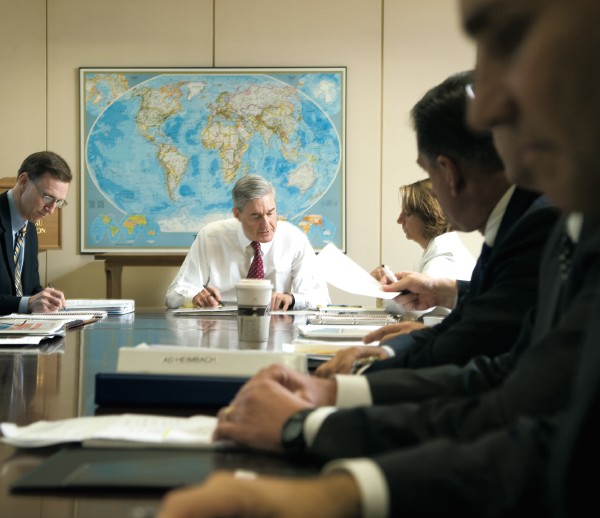
When Mueller sits down at his 9 am staff meeting each day, he need look no farther than his conference table to see the changing face of the FBI: His general counsel, his chief of staff, his HR director, his CIO, the chief of his national-security branch, and his public-affairs chief are all nonagents. A decade ago, they would have all been special agents. “That’s a big deal,” Packham says. “He fundamentally changed the nature of this organization by bringing in people with specific expertise.”
Dick Thornburgh, who serves on Mueller’s director’s advisory council, thinks the bureau’s transformation will take a generation—outlasting not just Mueller but the director after him.
Says Mueller: “It’s an ongoing challenge that’ll go long beyond my time.”
No FBI chief has ever lasted the full ten-year term. People who know Mueller say he will. “He’s genetically coded to do this,” says Rawls. As to what Mueller will do on September 5, 2011, when he leaves office, there’s only one answer. “I think he’d be most happy going back to DC and trying homicide cases,” jokes John Pistole.
Mueller doesn’t joke. Asked about his plans for the future, he points down Pennsylvania Avenue toward Judiciary Square and the DC Courthouse: “Homicide!”
This article first appeared in the September 2008 issue of The Washingtonian. For more articles like it, click here.